Guniting Contractors for Concrete Structure
Concrete deterioration is an inevitable phenomenon in reinforced cement concrete (RCC) structures exposed to environmental aggression, operational loading, material degradation, and inadequate maintenance. While concrete is inherently durable, prolonged exposure to moisture ingress, carbonation, chloride contamination, reinforcement corrosion, freeze-thaw cycles, chemical attack, and structural overstressing can progressively reduce the functional life of structural components.
In rehabilitation engineering, extending the service life of deteriorated structures is often more economical and technically feasible than complete demolition and reconstruction. Among various concrete rehabilitation techniques, guniting has emerged as a highly effective repair methodology for restoring damaged RCC members and enhancing structural durability.
Professional Guniting Contractors play a critical role in structural rehabilitation by restoring deteriorated concrete sections, protecting reinforcement systems, improving durability parameters, and reinstating the structural integrity of RCC components.
For aging buildings, industrial RCC systems, parking structures, retaining walls, bridges, water-retaining structures, and infrastructure projects, technically executed Guniting Services offer an engineered solution to prolong structural serviceability and delay capital-intensive replacement.
Understanding Concrete Deterioration in RCC Structures
The deterioration of concrete structures rarely occurs due to a single factor. In most rehabilitation projects, multiple deterioration mechanisms interact simultaneously, accelerating structural degradation.
Reinforcement Corrosion and Concrete Spalling
Corrosion-induced deterioration remains one of the primary causes of RCC distress. When chlorides, moisture, or carbonation penetrate the concrete cover, embedded reinforcement loses its passive protective layer and begins to corrode.
As reinforcement corrosion progresses, expansive corrosion products generate internal tensile stresses, leading to:
- Longitudinal reinforcement cracking
- Delamination of concrete cover
- Surface spalling
- Reduction in reinforcement cross-section
- Loss of bond strength between steel and concrete
Without timely rehabilitation, corrosion-induced distress may compromise load transfer mechanisms and reduce structural reliability.
This is one of the most common conditions where Guniting Contractors are engaged for rehabilitation and concrete reinstatement.
Structural Cracking Due to Stress Redistribution
RCC structures frequently develop cracks due to:
- Differential settlement
- Thermal movement
- Drying shrinkage
- Cyclic loading
- Fatigue stress
- Increased service loads
- Design deficiencies in older buildings
Although not all cracks indicate structural instability, untreated cracking allows ingress of water, chlorides, sulphates, and aggressive contaminants, accelerating internal deterioration.
Honeycombing and Construction Deficiencies
Improper vibration, poor compaction, inadequate shuttering, or segregation during concrete placement often result in honeycombing and porous concrete zones.
Such defects reduce concrete density and permeability resistance, increasing susceptibility to deterioration over time.
Environmental and Chemical Exposure
Structures operating in industrial, marine, sewage, or chemically aggressive environments experience accelerated degradation due to:
- Sulphate attack
- Chloride contamination
- Acidic exposure
- Wet-dry cycles
- Temperature variation
- Atmospheric pollutants
Without suitable rehabilitation intervention, deterioration rates can increase substantially.
Role of Guniting Contractors in Structural Life Extension
From a rehabilitation engineering perspective, guniting is not merely a surface repair method. It is a structural restoration process designed to reinstate section properties, improve durability performance, and arrest progressive deterioration.
Section Reinstatement of Deteriorated Concrete Members
One of the most important ways Guniting Contractors extend structural life is through the reinstatement of damaged RCC sections.
During rehabilitation, unsound concrete is mechanically removed until sound substrate is exposed. Corroded reinforcement is cleaned through mechanical means, abrasive blasting, or anti-corrosion treatment systems.
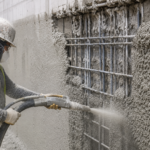
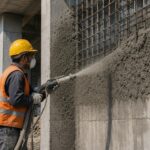
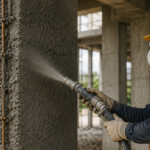
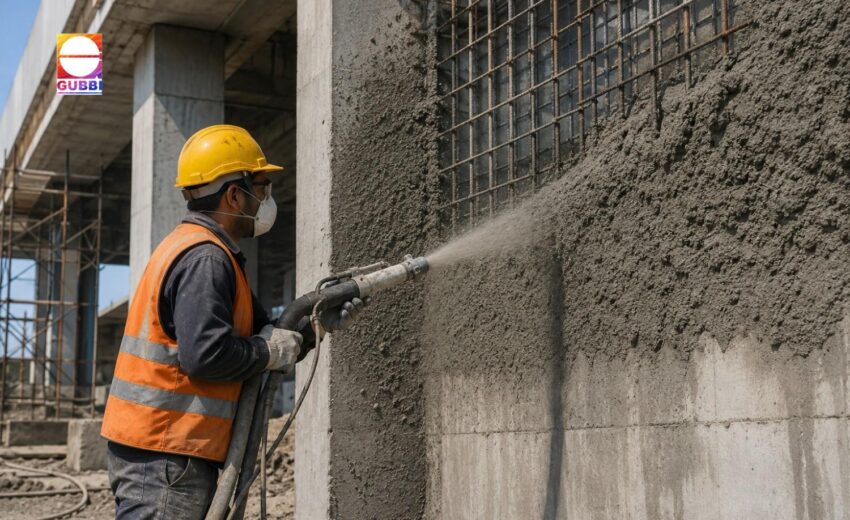
Following surface preparation, cementitious material is pneumatically projected under pressure onto prepared surfaces.
This process restores:
- Lost concrete section thickness
- Surface continuity
- Structural confinement
- Load distribution characteristics
For beams, columns, retaining walls, slabs, and RCC shells, this reinstatement significantly improves serviceability.
Improvement in Concrete Density and Reduced Permeability
A major technical advantage of guniting lies in its ability to produce dense and highly compact repair layers.
Because mortar or concrete is projected at high velocity, the repair layer achieves:
- Better compaction
- Reduced void formation
- Lower permeability
- Enhanced adhesion to substrate
Reduced permeability limits water ingress and slows corrosion progression in reinforcement systems.
For structures exposed to coastal conditions, industrial environments, or high-moisture exposure, professional Guniting Services help improve durability performance.
Arresting Corrosion Progression
Corrosion rehabilitation remains a critical objective in structural restoration projects.
Professional Guniting Contractors generally integrate multiple rehabilitation measures before spray application, including:
- Removal of contaminated concrete
- Rust removal from reinforcement
- Reinforcement passivation systems
- Polymer bonding agents
- Corrosion-resistant repair mortars
This systematic rehabilitation process helps interrupt active corrosion cycles and improve the residual lifespan of structural members.
Enhancing Structural Durability Under Operational Loads
Aging RCC buildings frequently experience changes in occupancy patterns and increased loading demands beyond original design assumptions.
Industrial floors, parking podiums, process buildings, and commercial facilities often require strengthening interventions to maintain performance.
Through controlled repair application, Guniting Services improve:
- Impact resistance
- Abrasion resistance
- Weather durability
- Surface strength
- Serviceability performance
This makes guniting particularly valuable in structures subjected to operational stress and environmental deterioration.
Minimizing Progressive Structural Damage
Delayed rehabilitation often transforms localized deterioration into widespread structural distress.
Minor cracking may evolve into:
- Reinforcement exposure
- Concrete disintegration
- Water infiltration
- Reduced durability performance
- Structural instability
By addressing deterioration at an early stage, Guniting Contractors help reduce progressive damage mechanisms and avoid large-scale rehabilitation expenditure.
Technical Applications of Guniting in RCC Rehabilitation
Professionally executed Guniting Services are commonly adopted in the following rehabilitation applications:
RCC Beam and Column Rehabilitation
Used to restore deteriorated concrete cover, repair corrosion-induced damage, and improve section durability.
Slab Rehabilitation
Applied in parking slabs, podiums, industrial floors, and suspended slabs experiencing deterioration.
Retaining Structures
Used for rehabilitation of retaining walls exposed to moisture pressure and environmental degradation.
Water-Retaining Structures
Commonly adopted in tanks, reservoirs, sewage treatment systems, and water infrastructure requiring dense impermeable repair layers.
Industrial RCC Structures
Factories, chimneys, warehouses, process plants, and heavy-load structures frequently require rehabilitation through guniting.
Key Indicators That Suggest Immediate Guniting Intervention
Property owners, consultants, and facility managers should consider engaging Guniting Contractors when structures exhibit:
- Concrete spalling
- Rust stains on RCC surfaces
- Reinforcement exposure
- Delaminated concrete cover
- Active leakage pathways
- Structural cracks in RCC members
- Honeycombed concrete
- Corrosion-induced distress
Early intervention significantly improves rehabilitation outcomes and reduces future repair costs.
Why Professional Guniting Contractors Matter?
The long-term success of rehabilitation depends heavily on workmanship quality and technical execution.
Improper surface preparation, poor mix proportioning, inadequate curing, or insufficient substrate cleaning may result in:
- Debonding failures
- Shrinkage cracking
- Reduced adhesion strength
- Premature repair deterioration
Experienced Guniting Contractors understand substrate preparation standards, repair sequencing, reinforcement treatment protocols, and material compatibility requirements necessary for long-term structural performance.
Conclusion
Extending the life of concrete structures requires more than superficial repair, it demands technically engineered rehabilitation.
Professional Guniting Contractors help restore deteriorated RCC elements, arrest corrosion mechanisms, improve structural durability, reduce permeability, and reinstate serviceability without complete reconstruction.
For buildings and infrastructure showing signs of concrete deterioration, early intervention through professionally executed Guniting Services can significantly improve residual structural life while reducing long-term maintenance liabilities and capital replacement costs.
Delaying rehabilitation often increases structural risk and repair complexity. Timely assessment and technically designed repair solutions remain essential for preserving the safety, functionality, and longevity of concrete structures.
Protect your RCC structure before damage worsens. Consult Gubbi Civil Engineers, guniting experts today.